
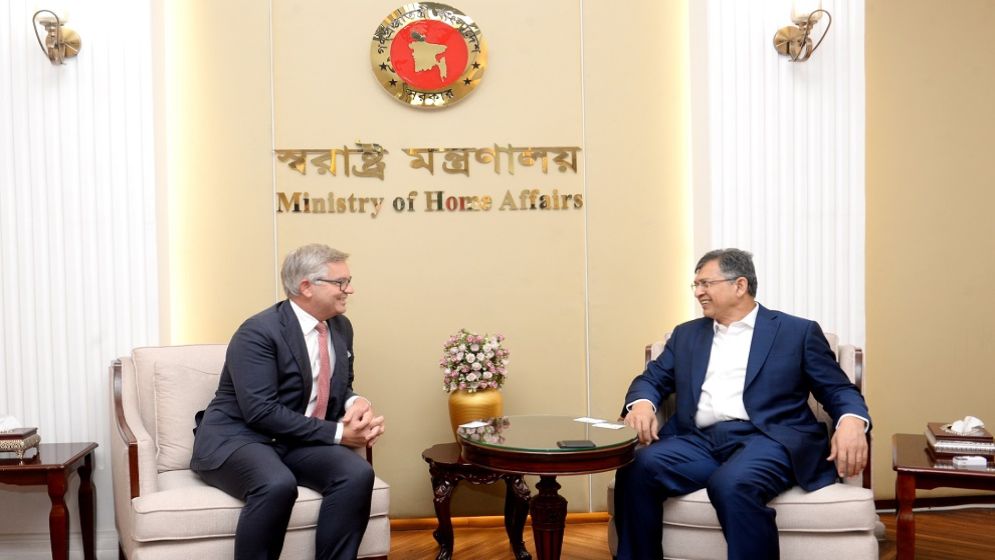
Home Minister Salahuddin Ahmed and European Union Commissioner for Home Affairs and Migration Magnus Brunner discussed measures to combat illegal migration and human trafficking at a meeting at the Bangladesh Secretariat in Dhaka on Monday.
They also discussed expanding the legal recruitment of skilled workers, strengthening border security and addressing the Rohingya crisis.
Brunner led a high-level EU delegation to the meeting at the home minister’s office on 12 October.
Salahuddin Ahmed said the Bangladesh government had adopted a zero-tolerance policy towards illegal migration and was committed to working with the EU to prevent human trafficking through dangerous and illegal routes and protect people seeking to migrate.
Bangladesh wants to reduce illegal migration to zero and create opportunities to send fully documented, skilled workers to the European labour market, he said.
Brunner praised the strategic partnership and cooperation between Bangladesh and the EU, saying preventing human trafficking and closing illegal migration routes were priorities for both sides. Reducing illegal migration would make it easier for Bangladeshi workers to enter the European labour market through legal channels, he added.
The meeting also discussed international-standard training and certification for Bangladeshi workers under the Talent Partnership project to accelerate legal migration.
The home minister said the government had invited training experts from EU member states to visit Bangladesh and provide direct training and certification to around 750 skilled workers facing complications in obtaining European certification. The EU delegation responded positively to the proposal, he added.
Salahuddin Ahmed also said an Advanced Passenger Information and Border Management System would be introduced at the country’s airports, seaports and land ports by the end of this year to monitor passenger traffic and identify criminals. The system will be connected to the Interpol database, he said.
The two sides also discussed establishing a direct institutional understanding between the Ministry of Home Affairs and the European Border and Coast Guard Agency (FRONTEX) to strengthen border management and technological capabilities.
On the Rohingya crisis, the home minister urged the EU to help build international pressure for a solution, warning that uncontrolled population growth and recent regional instability had turned the crisis into a serious threat to regional and global security, not just Bangladesh.
Bangladesh wants to reduce illegal migration to zero and create opportunities to send fully documented, skilled workers to the European labour market, he said.
Brunner praised the strategic partnership and cooperation between Bangladesh and the EU, saying preventing human trafficking and closing illegal migration routes were priorities for both sides. Reducing illegal migration would make it easier for Bangladeshi workers to enter the European labour market through legal channels, he added.
The meeting also discussed international-standard training and certification for Bangladeshi workers under the Talent Partnership project to accelerate legal migration.
The home minister said the government had invited training experts from EU member states to visit Bangladesh and provide direct training and certification to around 750 skilled workers facing complications in obtaining European certification. The EU delegation responded positively to the proposal, he added.
Salahuddin Ahmed also said an Advanced Passenger Information and Border Management System would be introduced at the country’s airports, seaports and land ports by the end of this year to monitor passenger traffic and identify criminals. The system will be connected to the Interpol database, he said.
The two sides also discussed establishing a direct institutional understanding between the Ministry of Home Affairs and the European Border and Coast Guard Agency (FRONTEX) to strengthen border management and technological capabilities.
On the Rohingya crisis, the home minister urged the EU to help build international pressure for a solution, warning that uncontrolled population growth and recent regional instability had turned the crisis into a serious threat to regional and global security, not just Bangladesh.
He sought active EU cooperation in exerting effective international pressure on the Myanmar authorities and the Arakan Army to ensure the safe, voluntary and dignified repatriation of Rohingyas to their homeland.
The EU delegation assured him of joint diplomatic efforts on the issue.
Other members of the delegation included EU Ambassador to Bangladesh Michael Miller, Director Henrik Nielsen, Cabinet member Grigorios Delavekouras and EU Deputy Head of Mission Baiba Zarina.
Additional Secretary to the Ministry of Home Affairs Dr Ziauddin Ahmed and senior officials from the home and foreign ministries were also present.
-BSS

