
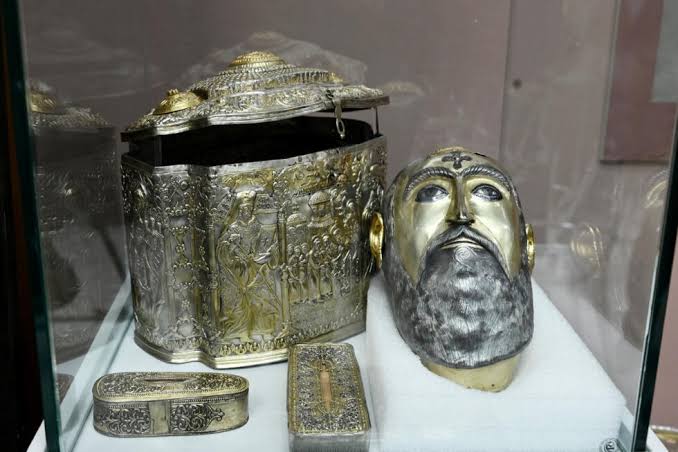
More than 1,000 years after his death, the
remains of what may be Tsar Samuel, one of the last major rulers of the First
Bulgarian Empire, are returning “home” on Saturday.
Greece and Bulgaria reached an agreement on their return this week, with
Bulgarian Prime Minister Rumen Radev hailing the accord as “historic”.
The remains “belong to our two peoples”, Radev said as he attended a ceremony
to mark the return alongside Greek counterpart Kyriakos Mitsotakis.
Greece will in return receive 48 objects pillaged by Bulgarian troops from
churches and monasteries in northern Greece during World War I.
Samuel, who reigned from 997 to 1014, led several campaigns against the
Byzantine Empire with his brothers, one of whom he later executed.
He gradually extended his authority over a swathe of the Balkans, making the
Lake Prespa and Lake Ohrid region, now mostly in North Macedonia, his
powerbase.
But the Byzantines regained the upper hand after 1001, soundly defeating
Samuel’s army in 1014.
Samuel is said to have died of shock when he saw thousands of his defeated
soldiers returning home blinded by order of Byzantine emperor Basil II, known
as the “Bulgar Slayer”.
Samuel’s state fell under Byzantine rule four years later.
While Radev said future generations would now be able to pay homage to their
ancestors, Mitsotakis hailed the remains as having “incalculable cultural and
spiritual but also emotional value”.
– Bones of contention –
But Bulgaria is not the only country to have claims on Samuel, with a huge
statue of the tsar gracing the North Macedonian capital Skopje.
His legacy has become a bone of contention between the two neighbours, with
Macedonians claiming him as “their” ruler.
The Skopje daily Sloboden Pechat called the handover another battle over
history, with the Albanian-language daily Koha declaring: “The bones return,
the conflict remains! Samuel once again (contested) between Skopje and
Sofia.”
Some historians have likened the dispute to the French and German tug-of-war
over Charlemagne.
In 2022, a bilateral commission recommended to present Samuel as the head of
a state that “most contemporary historiographers consider to be the Bulgarian
Empire”, based in what is currently North Macedonia.
“Samuel occupies an important place in the historical narrative both in
Bulgaria and in North Macedonia,” Dimitar Bechev, a researcher at the
Carnegie Europe think tank, told AFP.
“This initiative aims to underline the Bulgarian character of the Slavic
population of Macedonia.”
The supposed remains of Samuel were discovered by Greek archaeologist
Nikolaos Moutsopoulos in the 1960s.
Moutsopoulos led excavations on the Greek island of Saint Achilleios on
Little Prespa Lake near the border between Greece and Albania and not far
from the frontier with North Macedonia.
They found the skeleton of a man measuring about 1.6 metres (5 feet 3
inches), along with remnants of a rich silk fabric edged with gold and
decorated with bird motifs.
The attribution to Samuel is based on clues including the location of the
tomb, the sumptuousness of the garment, the age of the deceased and an old
fracture.
– Decades of negotiations –
Bulgaria officially opened talks on the return of the remains in 2007, and
they became a major issue in relations with Greece.
The deal this week also sparked a row in Bulgaria over who should claim the
credit, with history playing a major role in this month’s presidential
election.
Incumbent Iliana Iotova, backed by Radev and promoting ties both with Moscow
and the EU and NATO, is playing the patriotic card, having launched her
campaign in Veliki Preslav, former capital of the First Bulgarian Empire.
“Radev seeks to attract the patriotic electorate,” said analyst Bechev, with
the message that unlike other nationalist parties, “he delivers results”.
Free trains are being laid on to the capital for the occasion, with some 750
police guarding the centre of Sofia during the handover ceremony.
The remains attributed to Samuel will be laid in a white sarcophagus made
from marble quarried in the Prilep region of North Macedonia, public
broadcaster BNT said.
They will rest in the Church of Saint Sofia, a sixth-century basilica that
gave its name to the Bulgarian capital.
-BSS

