
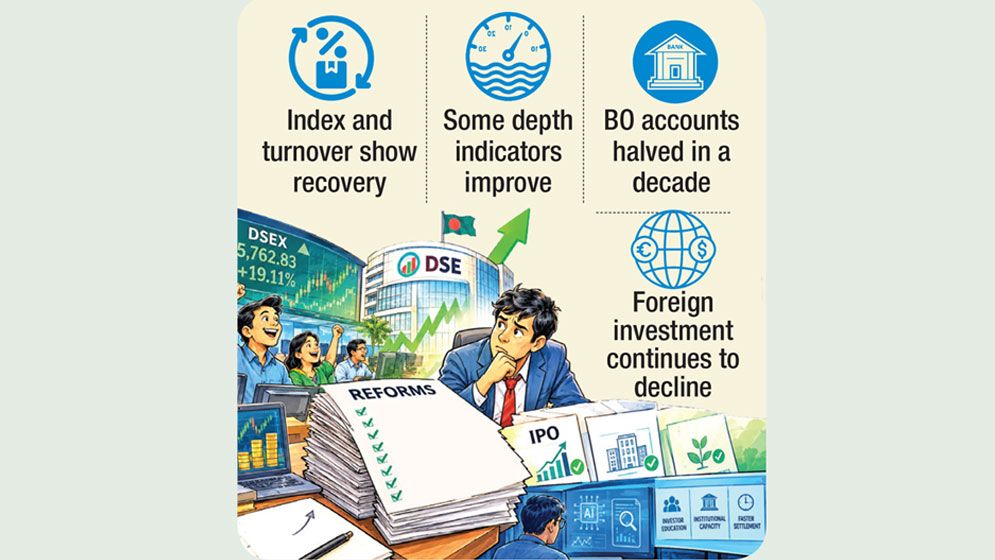
The capital market has posted its strongest rally in years, but the numbers behind the rally tell a more complicated story.
Since the political changeover of 5 August 2024, the securities regulator has scrapped floor prices, rewritten margin and public offer rules, and set up a reform task force – moves credited with pushing the DSEX up 19.11% and turnover velocity to a five-year high of 45.57% in the 2025-26 fiscal year.
Yet the investor base underpinning that activity has kept shrinking: BO accounts have nearly halved in a decade, to 16.75 lakh, and foreign investors pulled a net $223 million out of the market during the year – up from $138 million the year before.
Market participants say that while turnover and liquidity indicators have improved since the reforms began, questions remain over how durable the recovery is, and how far the regulatory changes have actually shifted investor behaviour or deepened the market’s structure.
Floor prices withdrawn first
The most visible post-5 August change was the exit from the floor-price regime. On 10 August 2024, the Bangladesh Securities and Exchange Commission (BSEC) lifted floor prices on Beximco, Khulna Power and Shahjibazar Power, followed on 14 August by BSRM, Islami Bank Bangladesh and Meghna Petroleum. The remaining floor prices on Beximco and Islami Bank were removed on 8 June 2026.
BSEC Chairman Masud Khan told the Daily Sun that floor prices would not return, and that his reform agenda prioritises price discovery, transparency, liquidity and investor confidence over artificial market controls.
Market participants, however, say the prolonged floor-price regime had already dented foreign investor confidence.
DSE Brokers Association (DBA) President Saiful Islam said past policy decisions, floor prices among them, had adversely affected sentiment among overseas investors.
Institutional changes
Beyond floor prices, BSEC formed a five-member reform task force after 5 August 2024, which, according to Bangladesh Bank’s Financial Stability Report, submitted its findings on 10 February 2025 after reviewing the Securities and Exchange Commission Act, margin rules and public issue rules.
New margin and mutual fund rules followed in 2025, and the Public Offer of Equity Securities Rules 2025 were gazetted in January 2026.
Draft whistleblower protection rules, corporate restructuring rules and direct listing rules have also been prepared.
What the numbers show
DSEX rose 924 points, or 19.11%, to close at 5,762.83 on 30 June 2026 – a picture corroborated by Bangladesh Bank’s June 2026 capital market review. DSE’s market capitalisation rose by roughly Tk36,421 crore, or 5.49%, to nearly Tk6.98 lakh crore over the same period.
Daily turnover rose from Tk464 crore a year earlier to nearly Tk1,500 crore by the close of the financial year. Turnover velocity reached 45.57% in June 2026, against 9.72% in June 2025 and a sharp rise from May’s 24.91%.
DSE attributes the increase to higher trading activity, improved liquidity and stronger investor participation.
BO accounts halved in a decade CDBL data show BO accounts falling from 31.53 lakh in July 2016 to around 16.75 lakh by the end of 2025-26 – nearly halved in ten years.
Live figures as of 23 September 2026 put active BO accounts at 16,65,585, of which 12,03,366 held shares, 3,87,744 held none, and 74,475 had never been used.
Investor representative Anam Ataullah Naeem told the Daily Sun that although roughly 16.66 lakh BO accounts exist on paper, only 12 lakh actively hold shares – evidence, he said, that while trading activity has picked up, long-term investor confidence has not been rebuilt.
DBA President Saiful Islam pointed to weak returns, a shortage of quality new listings, an ongoing IPO crisis and poor corporate governance as the main reasons investors are leaving.
Foreign investment still falling
Foreign investors withdrew a net $223 million from the market in 2025-26, up from $138 million the previous year, DSE data show.
Saiful Islam attributed the decline to weak corporate earnings, banking-sector troubles, currency risk and broader negative sentiment, adding that past policy interventions, including floor prices, continue to weigh on foreign confidence.
Domestic turnover may have risen, he said, but that has yet to translate into renewed foreign inflows.
Margin rules revised
Amended margin rules published in August 2026 fixed the margin loan ratio for listed shares at 1:1, allowing investors to borrow up to the value of their own equity, while lowering the minimum investment threshold for margin facilities from Tk5 lakh to Tk3 lakh.
The revised system provides for margin calls, and share sales where necessary, if equity falls below the prescribed limit – opening the door to greater participation from smaller investors, but also raising leverage risk during downturns.
IPO and direct listing reform
Raising secondary-market turnover alone will not deepen the market; quality new listings are also needed.
The new public offer rules aim to make the IPO process more market-based, and BSEC held consultations with market participants in July 2026 on strengthening financial disclosure, regulatory oversight and investor protection.
A draft direct listing framework – allowing eligible companies to list without going through the IPO route – was also put out for consultation in early September.
Masud Khan said bringing quality companies to market remains a repeated priority, without which the market cannot develop as intended.
He added that there is no longer scope to offer fresh incentives to multinational and large corporate houses; under the policy now being framed, companies performing well in Bangladesh will be required to list.
Mutual funds and surveillance
New mutual fund rules were framed in 2025, and in May 2026 closed-end funds were given the option to convert to open-end structures.
Masud Khan has spoken of reforms to governance, accountability, disclosure and asset valuation in mutual funds, alongside efforts to draw in more pension, insurance and institutional investment.
BSEC’s broader reform programme also covers technology-based surveillance, investor education and institutional capacity-building, with the gazetted whistleblower protection rules intended to strengthen disclosure of material information.
Masud Khan’s plan additionally includes cutting paper-based processes in favour of digital systems, AI-based surveillance and faster settlement – with T+1 settlement already implemented as a priority.
-DailySun

