
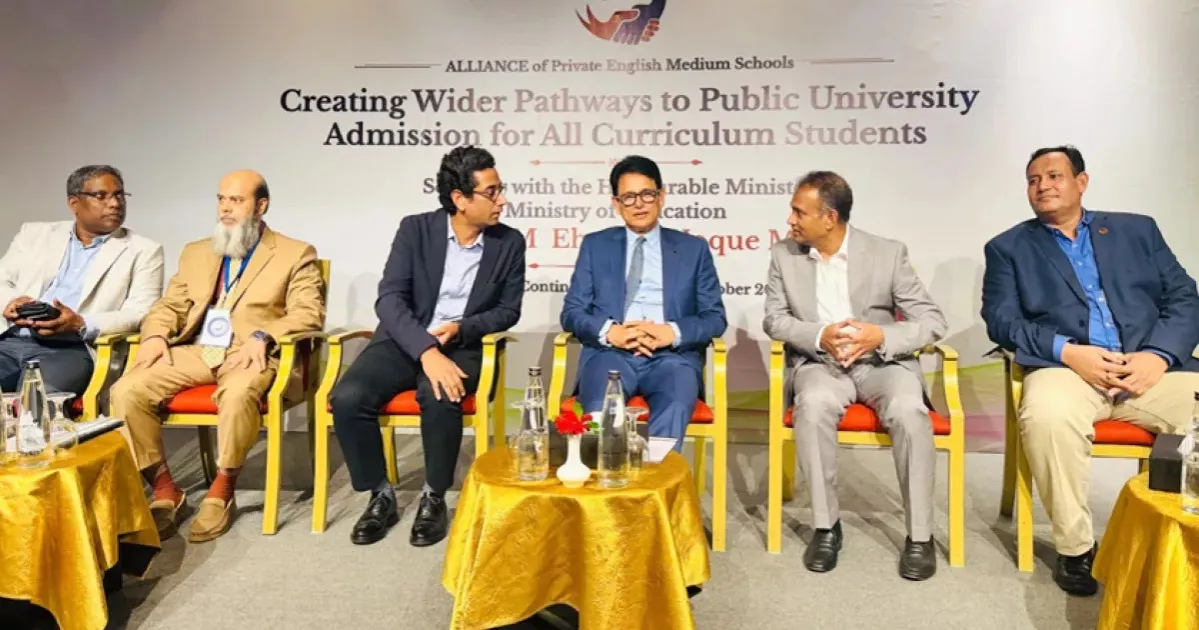
Education Minister ANM Ehsanul Hoque Milon Sunday said the government is determined to bring English-medium O Level and A Level education, and its students, into the mainstream.
“I wanted to bring English-medium education under a regulation before, but for some reason it could not be done,” Milon said at a seminar at a city hotel at Karwan Bazar.
The seminar was themed on expanding public university admission opportunities for students of national and international curricula and ensuring a fair and inclusive environment in higher education.
The minister criticised the lack of interest among English-medium students in Bangladesh’s public universities as well as the limited scope for their admission.
Sharing a recent experience, he said only two of nearly 1,000 students at a Jahangirnagar University orientation were from English-medium backgrounds.
“This can hardly be good news,” he said.
Holding universities and the University Grants Commission (UGC) equally responsible for the low admission rate, the minister said neither could shirk accountability.
Noting that many English-medium graduates once rose to important positions in the country and proved their merit, the minister said, “That is not seen now. We have to find out why English-medium students are failing to contribute to the country.”
Participants at the seminar discussed policy, structural and procedural barriers facing students of international curricula in entering higher education.
Key issues included eligibility for public university admission, equivalence of international qualifications such as O Level and A Level, application procedures, and the alignment of admission test structures with the academic preparation of students from different curricula.
Speakers emphasised ensuring fair opportunities for students of all curricula while maintaining merit-based selection and academic standards.
They also explored ways to make the admission system more transparent, easier to follow and inclusive, taking into account differences in content and assessment between national and international curricula.
The seminar also touched on the entry of international curriculum students into medical colleges, engineering universities and other higher education institutions.
-UNB

