
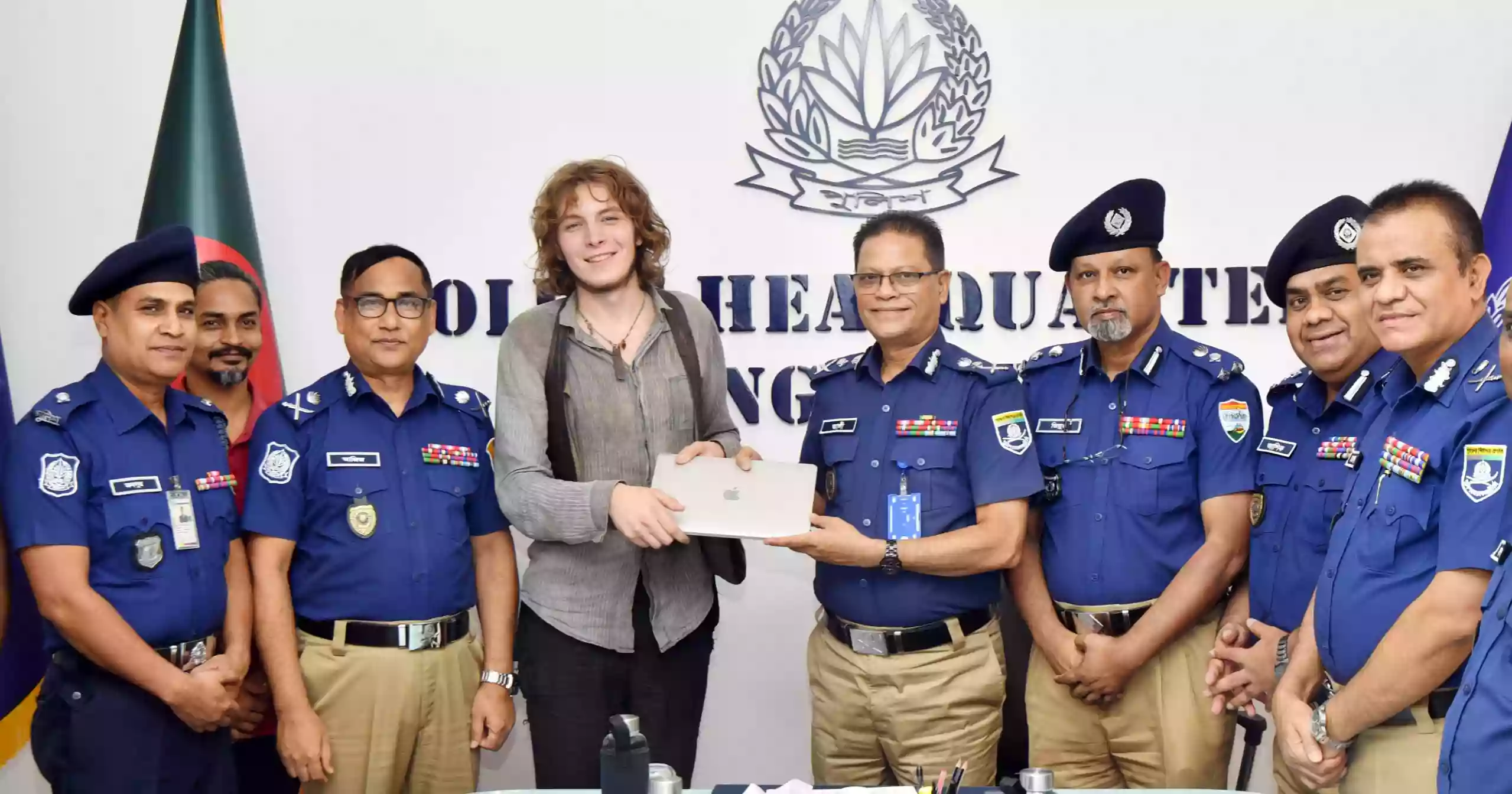
German tourist Kirill Lander-Weber on Tuesday got back his laptop, which was stolen from Natore Railway Station.
Inspector General of Police (IGP) Md Ali Hossain Fakir formally handed over the laptop to him at Police Headquarters in the morning.
Additional inspectors general and other senior police officials were present at the handover ceremony.
Kirill arrived in Bangladesh on September 23 to explore the country’s historical and tourist attractions.
On October 7, he reached Natore Railway Station and was waiting in the station’s waiting room to travel to India through the Darshana border.
He left his laptop and camera in the waiting room while going to a nearby ATM booth to withdraw money. Upon returning, he found the devices missing and sought police assistance at Natore Police Station.
The missing laptop contained important documents and records of his activities over the previous six months.
Following his written complaint, teams from Natore Sadar Police Station, Natore District Police, Railway Police and Tourist Police launched a joint operation to recover the missing laptop and camera.
After frantic efforts, police recovered the tourist’s MacBook from Noor Clothing Store in Sadar upazila of Natore adjacent to the Natore Sadar Police Station at around 9:30pm on October 11.
Kirill expressed his gratitude to Bangladesh Police and shared his positive experiences during his visit to Bangladesh, according to a press release.
In recognition of their contributions to the swift resolution of the foreign tourist’s complaint, recovery of the laptop and enhancement of the image of Bangladesh Police, the IGP financially awarded Natore Sadar Police Station Officer-in-Charge Md Monsur Rahman and Sub-Inspector Mohammad Shahadat Hossain.
He praised the officers for their efficiency, sincerity, sense of responsibility and teamwork.
The IGP also directed all units of Bangladesh Police to ensure prompt and professional services, provide security to both local and foreign citizens, build public trust, promote a tourist-friendly environment and set exemplary standards in public-oriented policing.
-UNB

