
Maruf Kamal Khan
The most significant day in the political history of independent Bangladesh was 7 November 1975. As the Day of the Sepoy-People’s Revolution and Solidarity, this date remains a shining and enduring landmark in our national history.
A brief background
To understand the nature and inevitability of the revolution and solidarity of 7 November, it is necessary to look briefly at the events leading up to it. We must revisit the long struggle to establish an independent Bangladesh and the armed Liberation War that ultimately brought that struggle to its its culmination.
Our struggle for independence was a prolonged and continuous process that advanced in successive stages. At various turning points in history, many fell away from this process, while some betrayed its cause. Similarly, at the beginning and towards the end of the Liberation War, a substantial section of the people’s elected political leadership betrayed the struggle. As a result, the war came close to being left without leadership at its outset. A similar situation arose at the final stage because of divisions within the leadership.
Consequently, the glory of victory was handed over to the Indian Army, bringing our national Liberation War to a halt. Because of the betrayal of the political leadership, Bangladesh’s independence increasingly came to be regarded as a ‘gift from India’. Yet countless Bangladeshis gave their lives in the Liberation War, many were permanently disabled, millions endured indescribable torture, and innumerable women were subjected to sexual violence. It was their boundless sacrifice and heroic struggle that drew India directly into the war.
By signing a secret treaty of subservient alliance with India, the then Bangladesh government-in-exile placed the Mukti Bahini under the command of the Indian Army in the name of a so-called joint command. After the Pakistani occupation forces surrendered to the Indian military at Dhaka’s Racecourse Ground on 16 December 1971, control of Bangladesh passed into India’s hands.
The government-in-exile was subsequently brought to Dhaka and installed in power, but Indian advisers were placed over it to supervise its activities. In short, although nine months of war culminated in the birth of an independent state called Bangladesh on the world map in late 1971, the country did not attain genuine sovereignty.
Indian experts openly declared on Bangladeshi soil that the country’s economy, defence, culture, national interests—in fact, everything—would serve as a complement to Indian interests. But the people of this country had fought Pakistan to establish an independent and sovereign state, not to build a country that would serve Indian interests.
Mujib’s return: a reversal of expectations
Through the process of its war of independence, Bangladesh had entered the orbit of the Soviet-Indian axis. The Americans, however, believed that Sheikh Mujib would do nothing contrary to US interests. The Pakistanis, too, began to hope, in the changed circumstances, that the past was past and that Sheikh Mujib could play an appropriate role in establishing a confederation-like bond between the two independent states.
Mujib returned home having agreed to these proposals. But, from the moment of his return, he tried, in his characteristic manner, to claim sole credit for the long struggle for independence and the success of the bloody war.
At the same time, he began taking calculated steps to move Bangladesh out of the Soviet-Indian orbit. He removed Tajuddin Ahmad, regarded as pro-Soviet and pro-Indian, from the post of Prime Minister, changed the system of government and assumed the premiership himself. Soon afterwards, he dropped Tajuddin from the cabinet altogether and leaned more towards Khondaker Mostaq Ahmad and other pro-American figures.
He also asked Indira Gandhi to withdraw Indian troops from Bangladesh and succeeded. At the time, the United States, China and the United Nations opposed the presence of Indian troops in the country.
Sheikh Mujib visited Pakistan to attend an Organisation of Islamic Cooperation (OIC) summit and welcomed Pakistani Prime Minister Zulfikar Ali Bhutto to Dhaka. He also began secret lobbying to establish relations with China, the United States and Middle Eastern countries, including Muslim nations. He abandoned demands for the trial of members of the Pakistani occupation forces and announced a general amnesty for those who had opposed Bangladesh’s independence.
All these steps were intended to fulfil commitments he had made to Pakistan and the US administration. But he could not go very far. The newly established Bangladesh was tightly bound within the Soviet-Indian sphere of influence. Pro-Indian figures controlled key positions in the ruling party and the administration. Sheikh Mujib was therefore forced to submit to them.
Mujib broke his promises and changed course. He adopted socialism despite his lifelong convictions. The Indians had never fully trusted him. They had already become angered by some of his actions, including his decision not to go to India and his arrest by the Pakistani Army on the night of 25 March 1971.
He now lost the confidence of the US administration as well. He had already lost public trust. The ruling party’s incompetence, inefficiency, plunder, exploitation, repression and violence had weakened his political footing. Having lost American support, Mujib leaned even more heavily towards the Soviet bloc of that time.
Events then unfolded rapidly. In the name of establishing socialism, Mujib curtailed democracy and fundamental human rights and imposed the one-party authoritarian rule of BAKSAL. He stripped away freedom of speech and expression, press freedom and the independence of the judiciary. Only four daily newspapers were allowed to continue under government control, while publication of all other dailies and numerous weeklies and periodicals was banned.
Senior officials and professionals in all state bodies and institutions, including the armed forces, were required to join BAKSAL, the country’s sole political party. The terms of Parliament and the government were extended by three years without an election. All avenues for a democratic transfer of power were closed, and an arbitrary system of administration and governance, resembling medieval monarchy, was established.
 American retaliation: the birth of instability
Earlier, the Jatiya Rakkhi Bahini had been established as a parallel force to the armed forces, with considerable powers and privileges. As a result, members of the regular defence forces began to feel neglected. The country’s overall situation and a number of isolated domestic incidents also fuelled resentment among many army personnel.
When they saw that Sheikh Mujib had closed all peaceful and constitutional avenues for a change of government and completed preparations to entrench his rule permanently, their anger intensified.
Using this discontented section of the army, the pro-American faction within the Awami League seized power in a bloody coup in the early hours of 15 August 1975. Mujib and two of his close relatives were killed along with other members of his family. Khondaker Mostaq Ahmad, Mujib’s longtime friend and political associate, assumed the presidency.
The ordinary people accepted this sudden and unexpected change of power because they had become exasperated with the authoritarian rule of the Awami League and BAKSAL. But instead of bringing stability to the system of government, the coup gave rise to even greater conflict and instability.
The recently ousted pro-Soviet and pro-Indian faction of BAKSAL could not accept its defeat and began preparing a counterattack. Mujib had banned all political parties through BAKSAL. The semi-military government led by civilian politician Mostaq, in turn, abolished BAKSAL. As a result, not only political parties but politics itself disappeared from the country.
During this political vacuum, various vested-interest groups began using the armed forces as a means of pursuing their own agendas. Discipline and the chain of command within the defence forces, symbols of the country’s independence and sovereignty, broke down.
Taking advantage of the disorder, ambitious Army Brigadier Khaled Mosharraf, backed by a handful of officers loyal to him, launched a revolt aimed at removing Khondaker Mostaq and seizing power. The leaders of the 3 November revolt placed Army Chief Ziaur Rahman under house arrest. In a flagrant violation of the chain of command and the law, Khaled, a subordinate officer, removed Zia from his post as army chief and declared himself the new chief.
Khaled’s intentions exposed
Khaled, an ambitious officer, tried to win over factions of different political persuasions by telling them what they wanted to hear. But it soon became clear to many that his real objective was to seize power.
Despite his active support for the coup of 15 August 1975, Khaled told Mujib loyalists on 3 November that Mostaq’s government was illegal. He claimed that he wanted to overthrow it to avenge Mujib’s killing. In response, Mujib loyalists said that, once Mostaq was removed, Mujib’s vice-president, Syed Nazrul Islam, should be installed in power.
However, the mysterious jail killings occurred alongside Mostaq’s removal. A group of soldiers entered the prison and murdered four senior Awami League and BAKSAL leaders, including Syed Nazrul and Tajuddin Ahmad. Although Khaled professed ignorance of the killings, many people began to suspect him.
Brigadier Khaled reached an understanding with the military officers involved in the 15 August coup that they would be allowed to leave the country safely and later be given positions in diplomatic missions. Colonel Faruk, one of the officers, was his relative. Under the arrangement, Khaled’s wife accompanied the officers on their flight as a guarantee of their safety. Begum Khaled escorted them safely to Bangkok.
Despite these tactics and manoeuvres, Khaled could not consolidate his authority everywhere. He was unable to keep the radio and television stations operating for three consecutive days. Even after imposing martial law, he never occupied the highest position of state power. His attempt to take control of Bangabhaban weakened his authority within the cantonment itself.
Ordinary soldiers and officers openly expressed anger, uncertainty and suspicion over Khaled’s mysterious activities. To avert bloodshed and conflict within the armed forces, Khaled adopted a compromise arrangement following the intervention of General M. A. G. Osmani, the commander-in-chief of the Liberation War.
Chief Justice Abu Sadat Mohammad Sayem was installed as president and chief martial law administrator. The decision, taken hastily under immense pressure, was as unlawful as Khaled’s assumption of the army chief’s post. Having declared Mostaq’s government illegal, Khaled himself had taken an equally unlawful step.
Realising that army commanders objected to accepting him as chief martial law administrator, he appointed a civilian judge to the position. Even this failed to save him.
The pro-Soviet and pro-Indian factions were looking for a way to stage a comeback and were elated by Khaled’s revolt. Mujib loyalists gathered at the Dhaka University campus for a meeting. They then marched with a photograph of Mujib to his former residence at Road 32 in Dhanmondi to pay tribute to the slain leader. The gathering enthusiastically praised Khaled.
Khaled’s mother and brother, Rashid Mosharraf, a former land deputy minister in the Awami League government, also joined the procession. When news of this spread, anger grew throughout the army and elsewhere. Soldiers and officers used various channels to communicate and exchange views, deciding to frustrate Khaled’s ambitions for power.
Revolution and solidarity
From the first hours of 7 November, the atmosphere in military cantonments across the country began to change. Soldiers emerged onto the streets with weapons in hand, firing as they advanced. Armed contingents from each cantonment were dispatched towards the capital, reaching Dhaka in the final hours of the night.
After midnight, the soldiers’ uprising also began inside Dhaka Cantonment. They came out of their barracks firing their weapons. Ordinary soldiers freed the detained army chief, Zia, carried him on their shoulders and brought him out onto the streets.
As the situation turned against him, Khaled attempted to flee Bangabhaban by car. He and several of his associates were caught by soldiers on the streets of Dhaka. The enraged soldiers shot them dead. Shortly before this, several officers who had supported Khaled—including Colonel Malek, Shafayat Jamil, Zafar Imam and Major Hafiz—had assessed the situation and abandoned him, fleeing to safety.
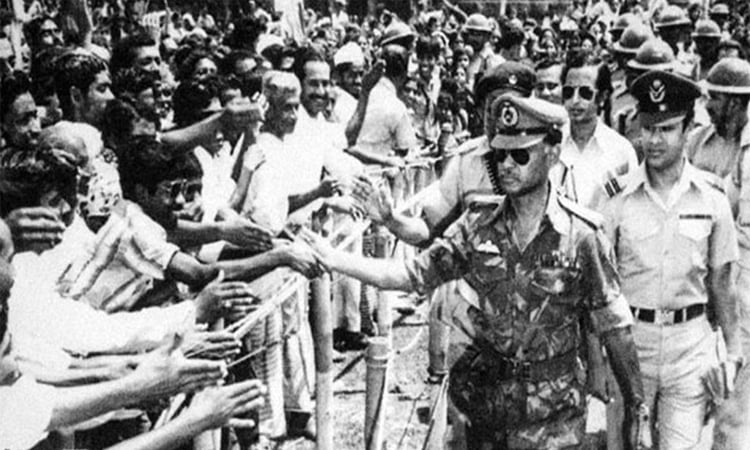
As soldiers took to the streets at dawn on 7 November, chanting, ‘Long live Bangladesh! Down with the conspirators! Long live Ziaur Rahman!’, people across the country came out spontaneously to support them.
People of every social class and profession, young and old, men and women, joined the soldiers defending the country and raised slogans alongside them. Hundreds of thousands of people waiting on both sides of the streets greeted the military contingents with thunderous applause. A shower of flowers from the crowds covered tanks and armoured vehicles. Ordinary people placed garlands around the barrels of cannons.
It was an extraordinary sight. Nothing like it had been seen since Bangladesh’s Liberation War.
Three important similarities
Three important parallels can be identified between the War of Independence and the events of 7 November.
First, at both turning points in the nation’s history, soldiers and ordinary people joined forces, standing shoulder to shoulder and risking their lives for the country.
Second, in both instances, ordinary soldiers and the public were compelled to step forward because those entrusted with leadership had failed. In 1971, Sheikh Mujib, described here as indecisive, failed to declare and lead the War of Independence. In 1975, Khondaker Mostaq, from Bangabhaban, failed to thwart what the author describes as a treasonous conspiracy.
Third, Ziaur Rahman played an extraordinary role in both events.
When the genocide began on 25 March 1971, the elected leaders, according to the author, chose surrender and flight, leaving the people under attack without leadership and in a state of acute helplessness. In that dark hour, a voice came over the airwaves: ‘This is Major Zia speaking…’
Broadcasting the declaration of independence through the Kalurghat radio station in Chattogram, Zia gave the nation reassurance and direction. He did not merely make a verbal declaration; he also set the Liberation War in motion.
Similarly, in the early hours of 7 November 1975, the public once again heard the same voice over the radio: ‘This is Zia speaking.’ Everyone listened attentively to the guidance of Zia, portrayed here as a leader at a time of national crisis.
Earlier, a handful of ambitious and misguided military officers, led by Brigadier Khaled Mosharraf and secretly allied with conspirators, had unlawfully removed and detained Army Chief Zia in a brief coup. Ordinary soldiers rose up against the plot. Leaving their cantonments and taking to the streets, they forged solidarity with the public. They freed the detained Zia and placed the responsibility of running the country in his hands.
However, the farsighted and patriotic Ziaur Rahman did not immediately assume responsibility for governing the state. Instead, he identified his urgent task as restoring discipline in the armed forces—the symbol of the country’s independence and sovereignty—and freeing them from conspiracies and conflict. The author argues that his firm and resolute handling of this national duty helped make the defence forces as strong as they are today. That, however, is a separate matter.
The central point is that one man stood at the heart of both the declaration of independence in 1971 and the soldiers’ and people’s revolution of 1975: Ziaur Rahman.
A conspiracy in disguise
In 1975, efforts to foment conflict within the armed forces were fuelled not only by incitement from certain quarters inside the country but also by external forces across the border.
When doubts emerged over the success of Brigadier Khaled’s coup, the conspirators outside the country activated their second front. Sensing ordinary soldiers’ resentment towards Khaled, a handful of members of the Jatiya Samajtantrik Dal’s (JSD) Gono Bahini and the so-called Revolutionary Soldiers’ Organisation joined the movement, claiming to share the soldiers’ grievances.
Their leader was Colonel Abu Taher, who had been removed from the army by Sheikh Mujib long before. The group’s purpose, according to the author, was to carry out sabotage. Disguising themselves as allies of the soldiers’ and people’s revolution, they began killing officers in an alleged conspiracy to leave the army without leadership.
In the early hours of 7 November, several members of the group began broadcasting misleading propaganda from the radio station, claiming that Colonel Taher was the leader of the soldiers’ and people’s revolution. Ordinary soldiers soon arrived and drove them out, after which the message of the revolution was broadcast properly.
Retired Colonel Taher subsequently went to Ziaur Rahman and sought to take him to the radio station. Brigadier Aminul Haque, who was present there, immediately intervened, denounced Taher as an agent of India and a traitor, and told him to leave.
Brigadier Haque feared that Taher’s group intended to kill Ziaur Rahman on the way under the pretext of taking him to the radio station.
In short, the author argues, Taher’s group’s ulterior motives were exposed on the night of 7 November itself. Its members were later tried and punished for their alleged conspiracy.
Two heads of the same snake
After years of engaging in what the author calls ‘mock fights’ as political opponents, the Awami League and a faction of the JSD later came together in the political arena. Their conduct and statements, he argues, made it clear that they shared the same roots.
In much the same way, Khaled and Taher were, in the author’s words, two heads of a two-headed snake. The Awami League and the JSD subsequently joined in praising both Khaled and Taher while condemning Ziaur Rahman.
This naturally raises a question: if Taher truly led a revolution against Khaled on 7 November, how can both men be supported? If Taher was the hero of 7 November, as his supporters claim, then Khaled must have been the villain. What, then, is the rationale for supporting these two opposing figures?
The author argues that the common rhetoric of the Awami League and the JSD reveals that Taher and his associates infiltrated the 7 November revolution to sabotage it. He maintains that the Khaled and Taher factions were linked by the same underlying purpose: to mortgage Bangladesh’s independence—not here, but somewhere else.
A day of officer killings
On 7 November, some misguided soldiers following Taher reportedly took up the killing of officers, chanting, ‘Soldiers and people are brothers; we want officers’ blood’—an act the author compares with the brutal killings of military officers at Pilkhana.
According to the article, ordinary soldiers, who represented the mainstream of the revolution, were not involved in these killings. As soon as Ziaur Rahman was freed, he courageously confronted this self-destructive activity. His resolute action quickly brought the bloodshed within the armed forces to an end.
Calling 7 November ‘Soldiers’ Killing Day’, therefore, would be, in the author’s view, a distortion of the truth. It was not ordinary soldiers who were killed that day; rather, some armed forces officers were killed by saboteurs. The author holds Colonel Taher and his followers responsible, noting that they were subsequently tried and punished.
He argues that there is at least a rationale for calling 7 November ‘Officers’ Killing Day’. To condemn the killing of these officers, he says, is also to support the trial of Taher and his associates and the sentences imposed on them.
Yet, according to the author, those hostile to the 7 November revolution continue to create a haze of propaganda rather than engage with the logic of the events. They claim that Taher was good, Khaled was good, the killings of 7 November were bad, and Zia—who stopped the killings—was also bad.
‘This country is truly remarkable,’ he writes. ‘Only here is it possible to say so many contradictory things in one breath.’
A staged kidnapping plot
To understand Colonel Taher’s and the Gono Bahini’s role on 7 November, the author says, another incident must be recalled.
During the same period of instability, on 26 November 1975, a group from the JSD’s Gono Bahini launched an armed operation against the Indian High Commission in Dhaka and attempted to abduct Indian High Commissioner Samar Sen. The attempt was foiled by timely action by Bangladeshi security personnel responsible for the mission’s protection. The exchange of gunfire resulted in casualties.
Two of Colonel Taher’s brothers took part in the operation.
According to political analysts cited by the author, the Gono Bahini’s armed adventure, following its failure on 7 November, was carefully planned and part of a deep conspiracy. After the change of power in Bangladesh in 1975, India had been unable to launch a military operation despite its desire to do so, owing to a warning from the superpower United States of America.
The author argues that the staged attempt to abduct High Commissioner Samar Sen was designed to create a pretext for a subsequent Indian military intervention in Bangladesh. The security forces thwarted the attempt.
He maintains that this group had joined the soldiers’ and people’s revolution under the guise of friendship, with the aim of leaving the armed forces without leadership, causing bloodshed and pushing the country towards a bloody civil war. That conspiracy, too, failed.
Paving a new highway
The lesson of 7 November, the author writes, is that during national crises and difficult times, soldiers and ordinary people must break down the walls that divide them and stand together. They must build an ironclad national unity and solidarity.
Another lesson of the revolution is that no one can escape accountability by capturing the highest posts in the armed forces while engaging in conspiracies against the nation. Ordinary soldiers of this country, he argues, remain vigilant guardians of national interests, independence and sovereignty, with the flame of patriotism burning within them. When necessary, they know how to leave their cantonments and forge bonds with the people in the streets.
The events of 7 November also serve as a stern warning against conflict and political factionalism within the armed forces. The revolution was a major act of resistance against ambitious military officers seeking to seize power through killings and conspiracies.
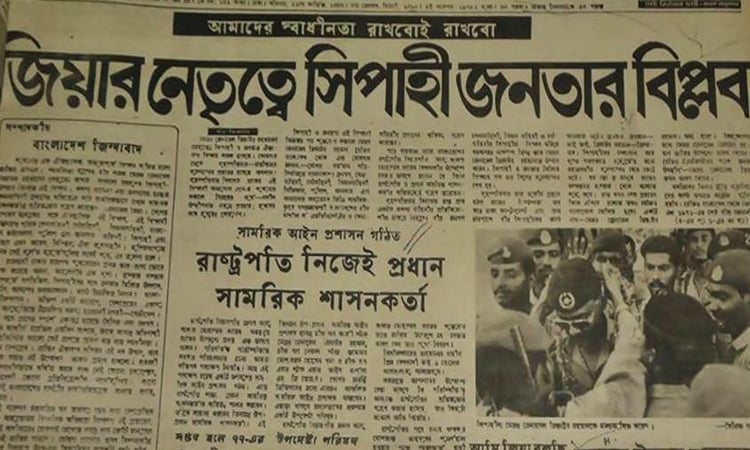
The Khaled faction’s attempt to seize power by violating the chain of command and military discipline through conspiracy was defeated by the soldiers’ and people’s revolution. The revolutionary soldiers and ordinary citizens freed Army Chief Zia and entrusted him with governing the country amid anarchy and a leadership vacuum. His accession to power was marked by showers of flowers from hundreds of thousands of soldiers and civilians gathered openly in the streets. The wave of the revolution swept away the conspiracy to seize power.
The significance of the 7 November revolution, the author argues, extends far beyond that day. Through the process set in motion by the revolution, open political activity returned to Bangladesh, political parties were formed, and the electoral process and multiparty democracy were re-established.
The revolution also freed the army from conspiracy and restored discipline and unity within its ranks. Through this process, Bangladesh achieved sovereignty from a position in which, according to the author, its policies had served Indian interests.
The nation-state of Bangladesh had been born through the Liberation War of 1971. Its citizens, the author maintains, subsequently acquired a modern, practical national identity rooted in the state itself.
He describes 7 November as the day this Bangladeshi national identity was inaugurated—renewed through self-awareness and a revived sense of identity. By helping the nation absorb the lessons and significance of the united revolution of soldiers and people, Ziaur Rahman, he concludes, laid a broad new highway along which this national identity could advance with its own distinct character, individuality, dignity, culture and pride.
(The author is veteran journalist and columnist. The article was originally written in Bengali and translated by Harun Al Nasif)
-BSS

